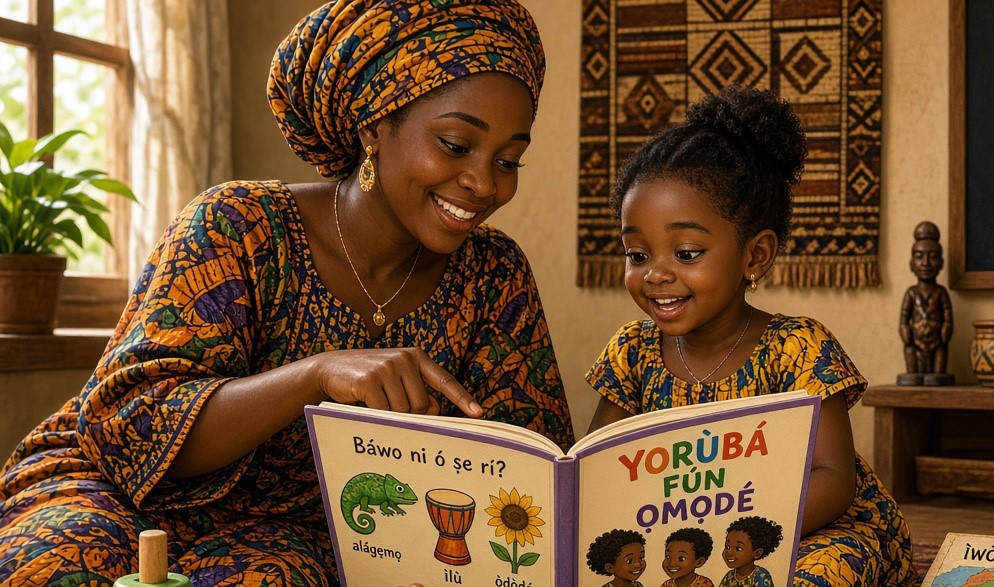
Why Teaching Kids Yoruba Early Matters
August 2, 2026
For a lot of Yoruba families, especially those raising children outside Nigeria — the language can quietly slip a generation. Grandparents speak it fluently, parents understand more than they speak, and children often understand very little at all. It doesn't happen because anyone stops caring. It happens because daily life runs in another language, and without deliberate effort, that's simply what a child absorbs.
Language is more than communication
A name's meaning, a proverb's punchline, the warmth in how a grandmother says a child's name, a lot of those lives inside the language itself, not just in translation. A child who can understand Yoruba has direct access to that part of their family and culture, instead of getting it secondhand, filtered through English.
Younger really is easier
Children between roughly three and twelve pick up new sounds, tones, and vocabulary with far less effort than teenagers or adults relearning a language later in life. Yoruba's tonal patterns in particular are much more natural to absorb early, through listening and repetition, than to consciously study later on.
It doesn't have to compete with anything
Parents often worry that adding a second language will slow down English or schoolwork. In practice, bilingual children generally adapt well, and the two languages develop side by side rather than one crowding out the other, especially when the second language shows up in short, low-pressure bursts rather than formal, high-stakes lessons.
Starting small still counts
Fluency isn't the only worthwhile goal. A child who can greet an elder properly, follow a folktale, or recognize their own name's meaning already carries something real. That foundation can always grow later, but it has to start somewhere.
That "somewhere" is exactly what we built YorubaQuest for: short, game-based lessons a child can return to on their own, backed by real native-speaker audio instead of guesswork.